
When a new plant variety is developed by a breeder, you may wonder which IPR protects it. In India, new plant varieties are protected under the Protection of Plant Varieties and Farmers’ Rights (PPV&FR) Act.
This law gives breeders certain rights over the new plant varieties they develop. It also protects the rights of farmers who conserve and develop plant varieties.
However, the exact rights depend on the type of registration and the provisions of the Act. So, the registered variety may have legal protection against unauthorized use, subject to the rules of the law.
When a farmer or breeder develops a new crop variety after putting in a lot of hard work, they should have legal protection for their work. In India, this protection is provided under the Protection of Plant Varieties and Farmers’ Rights Act, 2001.
If you have developed a new plant variety, you may be able to register it under this law. In this article, we will understand in very simple language how to get protection for a new plant variety and what benefits this protection can provide.

Hey brother, what is plant variety protection?
When we create something new, we usually have certain rights over it. In the same way, when a farmer or researcher develops a new variety of rice, sesame, cotton, wheat, or another crop, the law can provide protection for that variety.
In India, this protection is provided under the Protection of Plant Varieties and Farmers’ Rights (PPV&FR) Act, 2001. In simple words, plant variety protection gives legal rights to eligible breeders and recognizes the contribution and rights of farmers.
After registering a plant variety, the registered breeder can get legal rights over its use, subject to the rules of the law. Other people or companies may not be allowed to use or sell the registered variety without the required authorization.
If someone wants to use the protected variety for commercial purposes, they may need permission and may have to pay the applicable fees or royalty.
In India, plant varieties are registered and protected through the Protection of Plant Varieties and Farmers’ Rights Authority.
One important thing to remember is that your new plant variety must meet certain conditions to get legal protection. It should be new or distinct, uniform, and stable compared with existing varieties.
If your variety meets the required conditions, you can apply for registration under the PPV&FR Act. After completing the required process, the variety may receive legal protection.

What conditions must a new crop variety meet to get protection?
A new crop variety cannot be protected automatically. Certain conditions must be met before it can be registered.
You can get legal protection only if the variety meets the required criteria. There are four important conditions that need to be checked
1.Novelty: The new variety should meet the legal requirements for novelty. In general, it should not have been commercially sold or disposed of in a way that affects its eligibility for registration.
2.Distinctiveness: The new variety should have clear characteristics that make it different from other known varieties. These differences may be related to its appearance, growth, or other important features.
3.Uniformity: The plants produced from the variety should be sufficiently similar in their important characteristics, as required under the law.
4.Stability: The important characteristics of the variety should remain consistent when it is reproduced or grown over different seasons.
If the variety meets these requirements and passes the registration process, it can receive legal protection under the PPV&FR Act. This gives eligible breeders and farmers legal rights over their registered varieties according to the law.
What are the rights of farmers and the benefits of this law?
One important feature of this law is that it protects not only breeders and companies but also recognizes the rights of farmers. The Protection of Plant Varieties and Farmers’ Rights (PPV&FR) Act provides different rights and protections to eligible farmers.
One major benefit is that farmers can save, use, sow, resow, exchange, share, or sell farm produce, including seed, from their harvest, subject to the conditions and exceptions under the law. This helps farmers protect and continue using the plant varieties they have developed or conserved.
| Type of entitlement | What can you do? | What can’t you do? |
| Farmer’s Right | Sowing, reusing and storing seeds | Selling in large quantities under branded names |
| Researcher’s right | Creation and licensing of new varieties | Claiming another’s variety without permission |
| People’s Right | Using it for research | Defrauding the original owner |
If you develop a new plant variety, you may get financial benefits from it if it is registered and used commercially. It can also give you recognition for your work in the agricultural field.
With proper registration and legal protection, farmers and breeders may be able to earn from their varieties and create new business or employment opportunities.
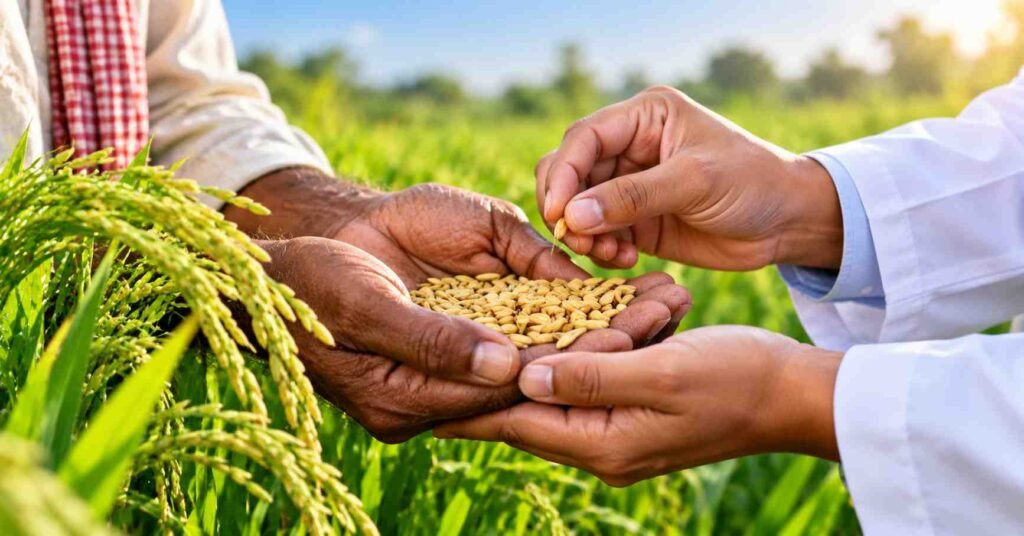
How to register a new plant variety? Follow these simple steps
Registering a new plant variety involves a few important steps. If you want to get legal protection for your variety, you need to follow the required registration process.
Let’s understand the process step by step in simple language
- Submit the application: First, you need to submit an application to the Protection of Plant Varieties and Farmers’ Rights Authority through the prescribed process.
- Submit seed samples: You may need to provide the required quantity of seed or planting material of your new variety for testing and evaluation.
- Field testing: The variety is tested and evaluated to check whether it meets the required conditions, such as distinctiveness, uniformity, and stability.
- Registration certificate: If the variety successfully meets the required conditions and the application is approved, a registration certificate is issued.
The registration process can take some time because the variety needs to go through proper testing and evaluation. Once registered, the variety can receive legal protection for the period provided under the law.
How does this system work in India and why is it important?
Agriculture is an important part of India. That is why protecting new plant varieties is important for farmers, breeders, and researchers. The Protection of Plant Varieties and Farmers’ Rights (PPV&FR) Act provides a legal system for registering and protecting eligible plant varieties in India.
This system also encourages people to develop new and better crop varieties. New varieties can offer useful qualities such as better yield, improved resistance to certain pests and diseases, or better performance under different growing conditions.
Protecting these varieties can also encourage more research and innovation in agriculture.
This system also recognizes the contribution of farmers who conserve and develop traditional plant varieties. If a registered variety uses genetic material or traditional varieties contributed by farmers, the law provides a mechanism for recognizing and rewarding eligible contributors.
The National Gene Fund was created under the PPV&FR Act to support benefit-sharing and other activities related to the protection of farmers’ rights. In simple words, it helps ensure that eligible farmers and communities can receive benefits when their contributions are recognized under the law.
What precautions should you take? Avoid common mistakes
Farmers and small breeders can sometimes make mistakes that may affect their ability to register and protect a new plant variety.
If you have developed a new variety, be careful before selling or sharing its seeds commercially. Under the PPV&FR Act, novelty requirements apply to new varieties, and certain prior sales or commercial use can affect whether a variety qualifies as new.
So, before selling your new variety in the market, check the registration requirements and applicable time limits carefully. This can help you avoid problems during the registration process.
You should also provide correct information and documents when applying for registration. Wrong or incomplete information can cause problems and may affect the registration process.
So, before submitting the application, check all the details carefully. If you are unsure about any requirement, it is better to take guidance from an expert or an authorized person.
Brief Summary of Rules and Legal Matters
This law is designed to protect the rights of farmers, breeders, and researchers while also considering the needs of the public. It also supports food security and the availability of seeds when they are needed.
In special situations, such as a serious shortage or emergency, the government has certain powers under the law to help ensure that seeds are available to farmers. In this way, the law aims to balance the rights of breeders and farmers with the wider needs of society.
Every farmer has the right to protect their crops and seek legal protection for new plant varieties they develop. By understanding and using these rights, farmers can protect their hard work and support the growth of better and more sustainable agriculture.
Important Disclaimer
This article is provided for general information and awareness purposes only. The information is based on the general provisions of the Protection of Plant Varieties and Farmers’ Rights Act and may not cover every legal situation.
For any legal process, application, registration, or official procedure, always check the latest information on the official website of the concerned Government of India authority or consult a qualified agricultural or legal expert.
Readers should verify all information before taking any action. Any decision made based on the information in this article is the reader’s own responsibility.
How to earn a good salary abroad or in India by making a career in an age care job? Learn the easy way
Frequently Asked Questions (FAQs)
Q 1. For how many years does a new crop variety get protection?
Answer: Generally, this cover is given for 6 to 15 years for field crops and up to 18 years for plants or vines.
Q 2. Can an ordinary farmer also register his own variety?
Answer : Yes, any farmer or group of farmers can easily register a new variety developed by them.
Q 3. Is there any fee to be paid for registration?
Answer : Special discounts and concessions are given to farmers in this registration process so that they do not face financial burden.
Q 4 What happens if registered seeds are stolen and sold?
Answer: It is a legal offence to do so. Penal and legal action is taken against the person or company who has committed fraud.

मी एक ब्लॉगर आणि कंटेंट रायटर असून गेल्या काही वर्षांपासून माहितीपूर्ण लेखन क्षेत्रात कार्यरत आहे. सरकारी योजना, रोजगार, शेती, ऑनलाइन कमाई आणि ट्रेंडिंग विषयांवर संशोधन करून वाचकांसाठी सोप्या भाषेत अचूक माहिती देण्याचे काम मी नियमितपणे करतो.
माझा उद्देश लोकांपर्यंत उपयुक्त, विश्वासार्ह आणि सहज समजणारी माहिती पोहोचवणे हा आहे. नवीन आणि महत्त्वाच्या विषयांवर सतत अभ्यास करून मी वाचकांसाठी दर्जेदार आणि माहितीपूर्ण लेख प्रकाशित करत असतो.